Mastering the Marketing Funnel
Cheat Sheet: Key tactics, content types, and metrics!

Thank you for downloading! Optimize every stage of your funnel and start driving lead conversion success!

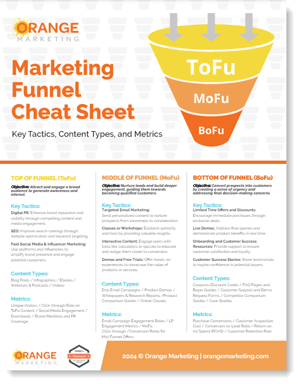
marketing funnel cheat sheet


Frequently Asked Questions

How does the Marketing Funnel Cheat Sheet help B2B marketers?

This cheat sheet is a quick-reference guide for B2B marketers who need to align their tactics, content, and KPIs to a specific stage of the buyer journey. It organizes the marketing funnel into three layers, ToFu, MoFu, and BoFu, and prescribes the right activities and metrics for each. 

What does ToFu mean and what is its goal in a B2B sales funnel?

ToFu stands for Top of Funnel. Its goal is to attract and engage a broad audience to generate brand awareness and initial interest before any purchase intent exists. In a B2B context, this typically means reaching decision-makers, procurement teams, or influencers who may not yet know your
company exists. Key tactics include SEO, Digital PR, and Paid Social or Influencer Marketing. 

What does MoFu mean and how does it differ from ToFu?

MoFu stands for Middle of Funnel. While ToFu is about casting a wide net, MoFu is about nurturing the leads already captured, moving them from general awareness into active consideration. In B2B, this is where trust and authority are built. Tactics include targeted email drip campaigns, webinars, workshops, interactive content like calculators or quizzes, and free trials or product demos. Metrics
shift from reach to engagement quality: email open/click rates, landing page engagement, and conversion rates on mid-funnel offers.

What does BoFu mean and what B2B-specific considerations apply?

BoFu stands for Bottom of Funnel. This is the conversion stage, where the goal is to turn qualified prospects into paying customers by addressing final objections and creating urgency. In B2B, buyers often involve multiple stakeholders, so content like case studies, competitor comparison guides, live demos, and ROI-focused testimonials are especially powerful here. 

Why is SEO listed as a ToFu tactic rather than applying to all funnel stages?

SEO is anchored at ToFu because its primary function is discovery, helping strangers find you via search before any relationship exists. That said, SEO supports all stages; it's placed at ToFu because that's where organic traffic first enters the funnel.

How should a B2B Marketer Decide which content type to use at each stage?

Content selection should match the prospect's level of familiarity and intent. At ToFu, use lightweight discoverable content (blog posts, infographics, videos, ebooks) that educates without requiring commitment. At MoFu, use content that requires deeper trust - whitepapers, research reports, product comparison guides, and email drip sequences. At BoFu, use highly specific proof-driven content like case studies, testimonials, FAQ pages, and buyer guides that directly answer 'why you over a competitor.'

Why are competitor comparison guides listed under BoFu rather than MoFu?

By BoFu, a prospect has already decided they need a solution, they're now choosing between vendors. Competitor comparisons serve that final evaluation moment. At MoFu, the prospect is still deciding whether to act at all, so comparisons are premature.

Can a single piece of content serve multiple funnel stages at once?

Rarely well. Content performs best when written for a specific level of buyer intent. A blog post optimized for awareness will feel too shallow for a BoFu buyer, and a case study feels too salesy for someone just discovering a problem. Stage-specific content consistently outperforms generic content.

How do drip email campaigns differ from standard email newsletters in a B2B funnel?

Newsletters broadcast the same content to everyone on a list. Drip campaigns are automated, behavior-triggered sequences personalized to where a prospect is in the funnel. In B2B, drips are far more effective because they deliver the right message at the right moment in a long sales cycle.